Over the last decade, mobile development has matured dramatically.
We’ve seen the rise of modern languages like Kotlin and Swift. UI frameworks such as Jetpack Compose and SwiftUI have reshaped how we build interfaces. Build systems, CI/CD pipelines, and testing frameworks have improved significantly.
From a developer productivity perspective, the mobile ecosystem is stronger than it has ever been.
But if we step back and look at the systems mobile applications now represent, a different picture begins to emerge.
Modern mobile applications have quietly evolved into complex distributed systems.
Yet much of the infrastructure we use to understand and reason about them still treats them like simple client applications.
Mobile Applications Are No Longer Just Clients
For many years, mobile apps were viewed primarily as thin clients interacting with backend services.
That model no longer reflects reality.
Today, mobile applications often sit at the center of critical digital systems. They handle authentication, payments, healthcare workflows, logistics operations, financial transactions, and communication systems used by millions of people every day.
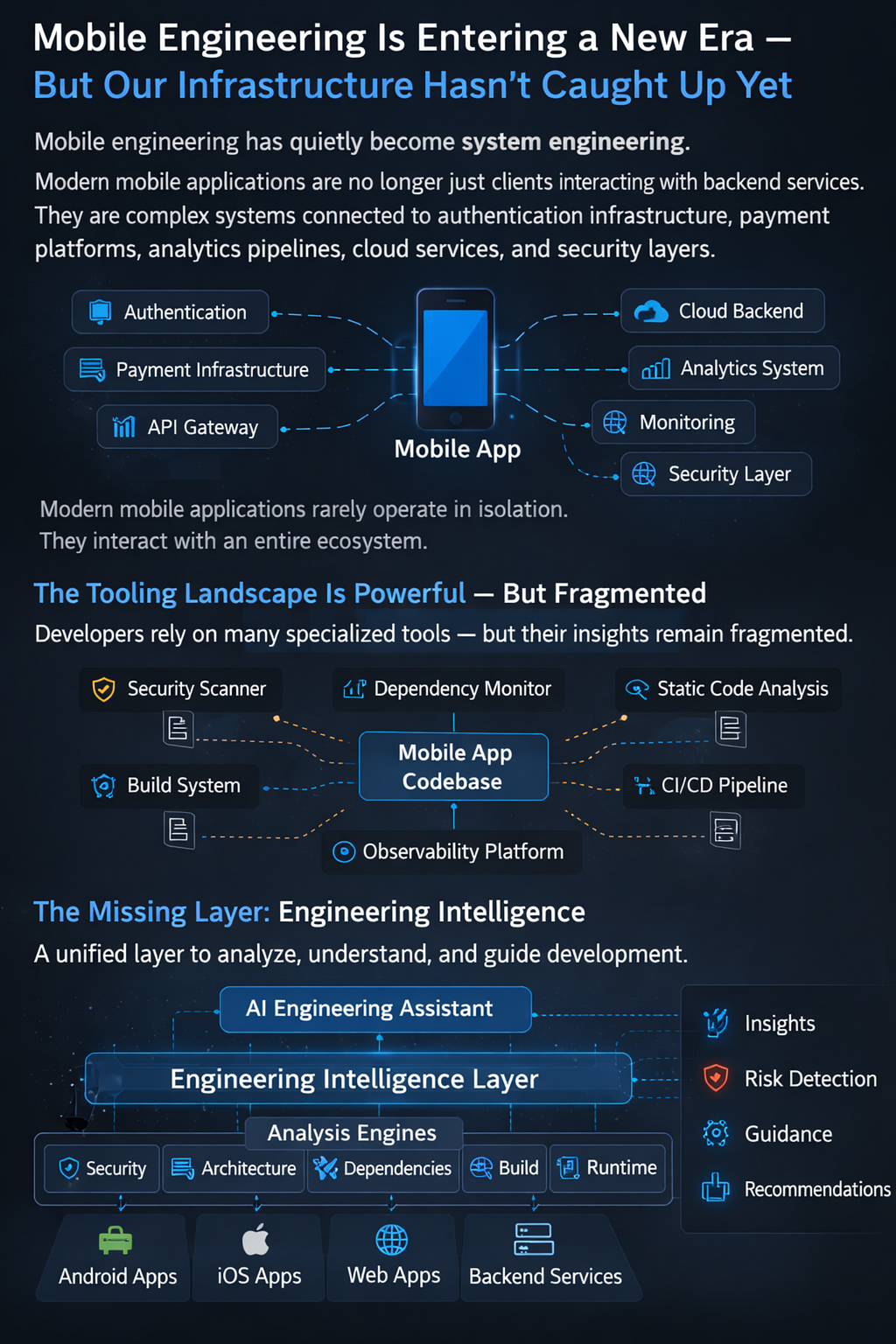
In large organizations especially, mobile applications interact with an entire ecosystem of infrastructure:
Authentication services
Payment platforms
Cloud backends
Analytics pipelines
Monitoring systems
Security layers
API gateways
Shipping a mobile release today involves far more than building screens and calling APIs.
Teams must constantly reason about things like:
- Security posture
- Dependency risk
- Architecture consistency
- Runtime behavior
- Build system stability
Anyone who has worked on a large Android or iOS codebase has likely experienced this firsthand.
Gradle builds that take minutes.
Dozens of third-party SDK dependencies.
Security checks before every release.
Architectural boundaries slowly eroding as systems evolve.
The signals that describe the health of these systems do exist — but they are often scattered across multiple tools and reports.
Developers spend a surprising amount of time simply trying to understand the current state of their application.
The Scale of the Mobile Ecosystem
The scale of mobile computing today is enormous.
Mobile devices now generate the majority of internet traffic worldwide.
Mobile Web Traffic
Mobile devices account for roughly 62–64% of global web traffic, while desktop devices account for about 35%.
Source: StatCounter Global Stats
Mobile Usage Behavior
Average smartphone usage is now 4–5 hours per day, and nearly 90% of that time is spent inside applications rather than browsers.
Source: Data.ai Mobile Usage Reports
Global Mobile Economy
Mobile technologies generated approximately $7.6 trillion in economic value globally in 2025, representing over 6% of global GDP.
Source: GSMA Mobile Economy Report
Mobile is no longer just another software platform.
It has become a foundational layer of global digital infrastructure.
The Tooling Landscape Is Powerful — But Fragmented
The mobile ecosystem has produced many excellent tools.
Security scanners detect vulnerabilities.
Dependency monitors track outdated libraries.
Static analysis tools highlight potential code issues.
Observability platforms help diagnose runtime failures.
Each of these tools provides valuable insights.
But they typically operate in isolation.
A security scanner may report vulnerabilities.
A dependency tool may highlight outdated packages.
An observability system may detect crashes or performance issues.
But there is rarely a coherent system-level view of the application.
Instead, engineers interpret multiple reports and mentally connect the dots across different tools.
This works — but it becomes increasingly difficult as systems grow larger and more interconnected.
Many engineers working on large mobile systems have likely felt this friction, even if we don’t always talk about it explicitly.
AI Is Now Entering the Development Workflow
At the same time, another shift is happening across the software industry.
AI-assisted development tools are becoming part of everyday engineering workflows.
Developers are increasingly using systems such as:
GitHub Copilot
Cursor
Claude Code
AI-powered development assistants
These tools are incredibly powerful. They can help developers explore unfamiliar codebases, generate implementations, suggest refactors, and explain complex logic.
But these systems primarily operate on source code and textual context.
They don’t inherently understand broader engineering signals such as:
- Security posture
- Dependency health
- Architectural boundaries
- Build configuration risks
- Runtime behavior
Yet those signals often determine the most important engineering decisions in complex mobile systems.
Mobile Engineering Is Quietly Becoming System Engineering
Modern mobile development requires reasoning across multiple layers simultaneously.
Engineers must constantly interpret signals related to:
Security
Architecture
Dependencies
Build infrastructure
Runtime behavior
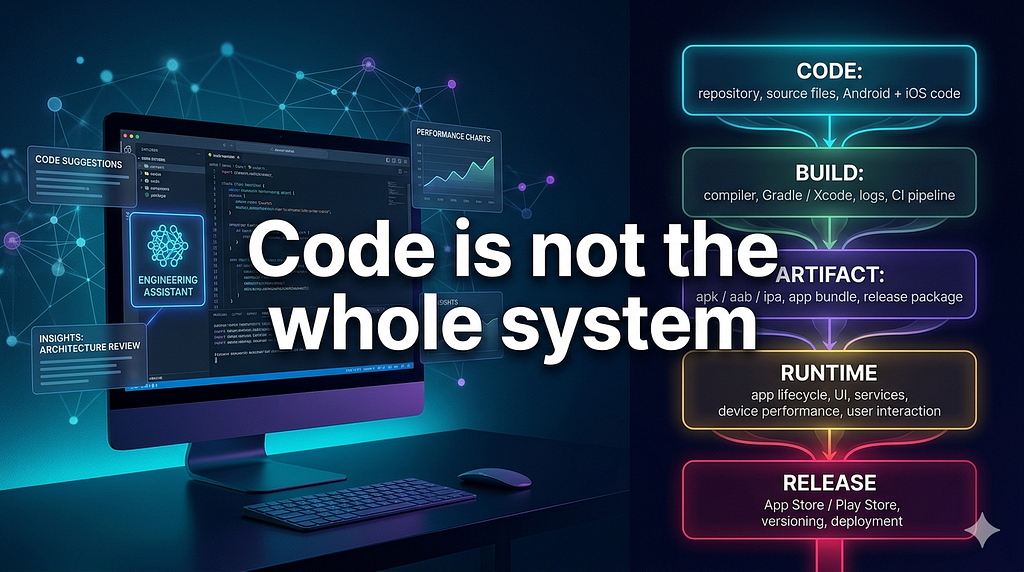
The application code itself is only one part of the system.
Understanding the application requires context across the entire ecosystem.
Today that context is mostly interpreted manually.
But as AI systems become more deeply integrated into development workflows, they will increasingly need access to structured intelligence about applications.
Not just code — but insights about the system surrounding that code.
The Missing Layer: Engineering Intelligence
This raises an interesting possibility.
What if the next generation of developer infrastructure focused on producing machine-readable intelligence about applications?
Instead of isolated tools generating fragmented reports, platforms could produce structured signals describing things like:
- Security posture
- Architecture structure
- Dependency health
- Configuration integrity
- System-level insights
Signals that both humans and machines can interpret consistently.
Such infrastructure could help developers reason about complex systems more effectively — and potentially allow AI systems to interact with engineering environments in more meaningful ways.
A Direction I’ve Been Exploring
These questions are part of what led me to start exploring a concept I’ve been calling A……..x.
The idea is not to build another isolated developer tool.
What I’m interested in exploring is whether we can create infrastructure that produces structured intelligence about applications, starting with the mobile ecosystem.
The goal would be to help developers better understand the health and posture of their applications across security, architecture, dependencies, configuration, and runtime behavior.
It’s still early thinking, but the challenge feels increasingly relevant as mobile systems continue to grow in complexity.
The Next Phase of Mobile Engineering
Mobile development has always evolved alongside the infrastructure supporting it.
We’ve seen this with:
Build systems
Testing frameworks
CI/CD pipelines
Observability platforms
The rise of AI-assisted development may push the ecosystem toward another shift.
One where applications are not only built and deployed — but also continuously analyzed and understood as systems.
Mobile engineering has quietly become system engineering.
The question now is what kind of infrastructure will support the next phase of mobile development.
For engineers working on large mobile systems today — especially in enterprise environments — I’d be genuinely curious to hear your perspective.
Do you feel like our tooling is keeping up with the complexity of the systems we’re building?
Mobile Engineering Is Entering a New Era — But Our Infrastructure Hasn’t Caught Up Yet was originally published in Stackademic on Medium, where people are continuing the conversation by highlighting and responding to this story.