As tools become more agentic, I keep wondering whether mobile engineering is revealing a deeper infrastructure gap.
Everywhere I look right now, the mood feels similar.
Someone is showing how fast they shipped a feature with Cursor
Someone else is using Claude Code
to inspect a codebase and fix bugs.
Someone is delegating part of the workflow to an agent and sharing the result like a glimpse of the future.
And to be fair, this is not fake momentum.
OpenAI now describes agents
as systems that can independently accomplish tasks on a user’s behalf within guardrails. Anthropic describes Claude Code
as an agentic coding tool that reads codebases, edits files, and runs commands. Cursor, meanwhile, is positioning itself as an AI-first editor built around codebase understanding, planning, editing, and workflow assistance across environments.
The productivity signals are real too. GitHub’s published research found that developers using Copilot completed a coding task 55% faster
in one controlled study. In later GitHub research, developers with Copilot access had a 53.2% greater likelihood of passing all 10 unit tests
in the study, and their code showed fewer readability issues in blind reviews. Microsoft’s 2025 Work Trend Index
says 82% of leaders see this as a pivotal year to rethink strategy and operations, and 81% expect agents to be integrated into their AI strategy within 12–18 months. Google Cloud has reported that 52% of executives
say their organizations are already deploying AI agents in production. Anthropic’s March 2026 Economic Index
says coding-related work accounts for 35% of Claude.ai conversations.
So this is clearly not a phase we can dismiss.
But the more I watch the excitement around assistants, copilots, and agents, the more one question keeps coming back to me:
Are these tools really understanding our systems — or are they getting much better at sounding like they do?
That question feels especially important in mobile engineering.
Why I keep coming back to mobile
I do not mean this as a grand statement. I mean it more as an observation from the trenches.
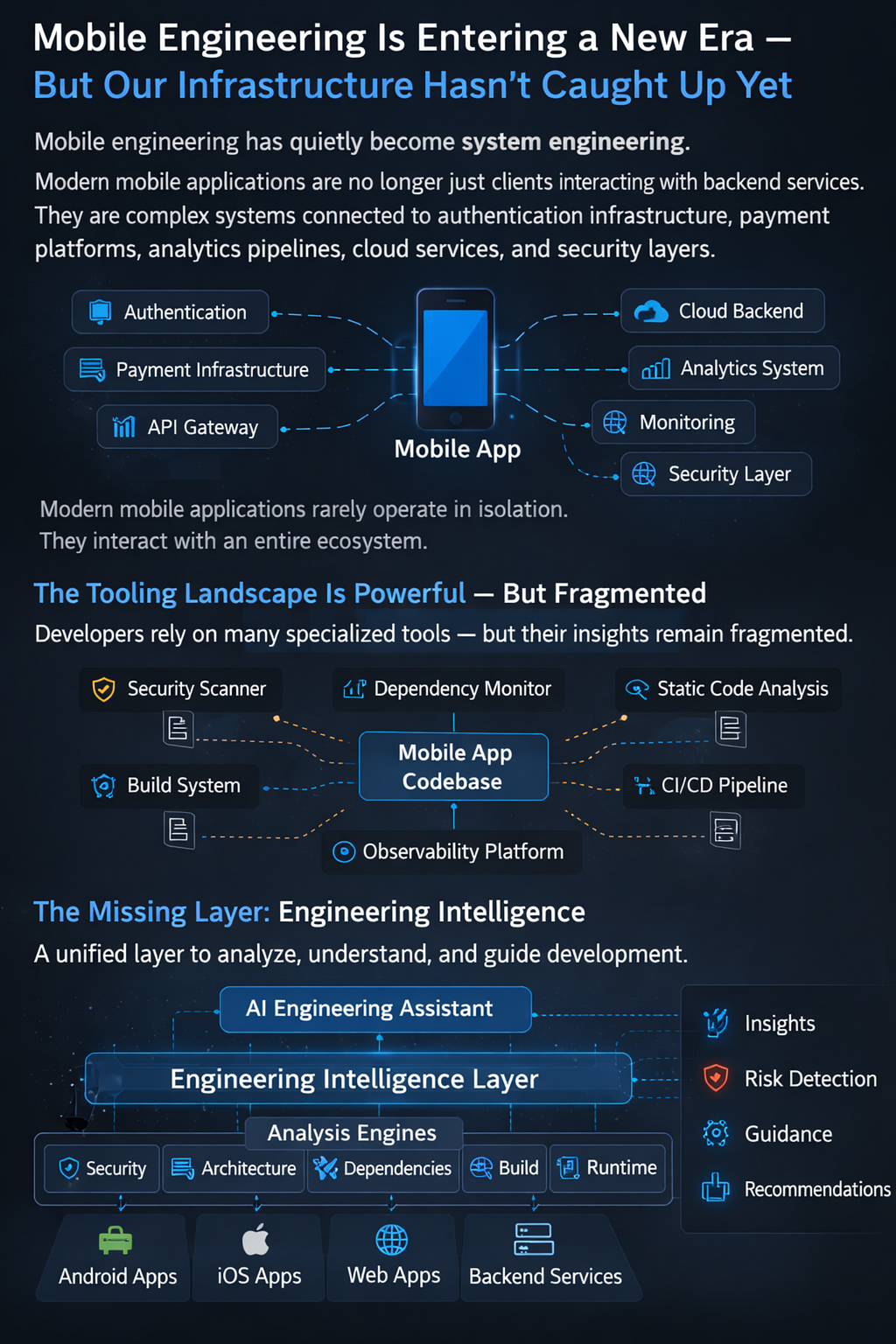
Mobile often gets discussed like it is simply another client layer. But in practice, modern mobile systems sit inside authentication flows, payment journeys, local storage, third-party SDK behavior, permission models, binary packaging, runtime constraints, release gating, and app-store review realities.
That is why I find mobile such an interesting lens for the current tooling wave.
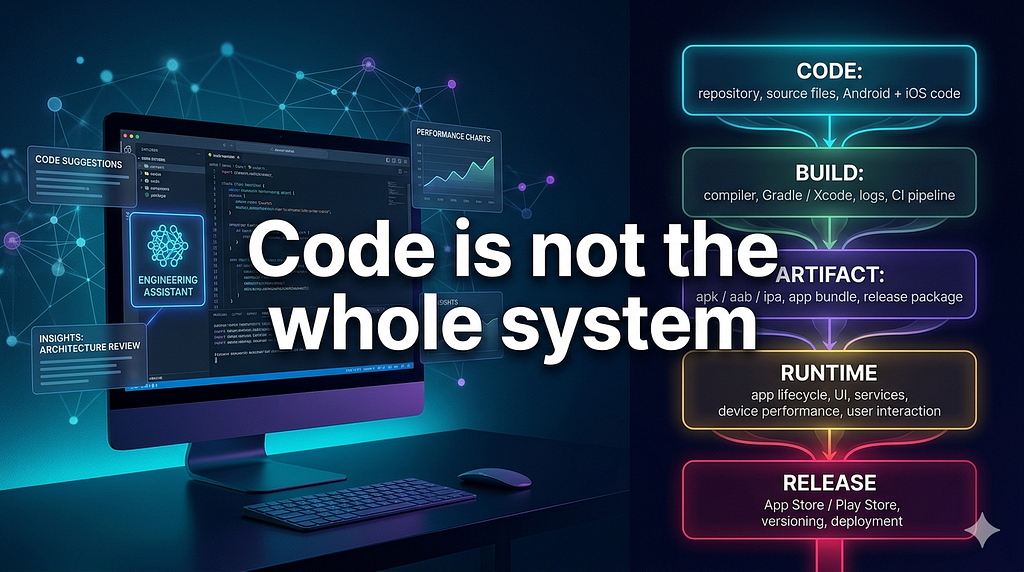
Because in mobile, code is never the whole story.
The code matters, of course. But so do the build, the artifact, the dependency graph, the runtime posture, the release process, and the trust boundary around what eventually lands on a user’s device.
And that is where I start to feel the tension.
A coding assistant may understand a class, a screen, a view model, a failing test, or a local bug very well.
But does it understand the system?
The confidence can look bigger than the understanding
One reason these tools are so compelling is that they are very good at producing the feeling of clarity.
You ask for an explanation, and you get one.
You ask for a refactor, and it gives you one.
You ask it to trace a flow, edit a few files, run commands, maybe even fix tests, and suddenly it feels like the tool understands the architecture.
Sometimes it probably understands enough for the task at hand.
But I keep wondering whether we are sometimes mistaking code fluency for system understanding.
Because a real application is not just a collection of files. It is also architecture intent, dependency posture, build configuration, artifact composition, policy constraints, runtime behavior, release context, and operational history.
That broader need for visibility is showing up elsewhere too. Microsoft Security recently argued that as AI systems become more autonomous, teams need clear, continuous visibility
into how those systems behave in production in order to detect risk, validate policy adherence, and maintain operational control.
That line stayed with me, because it feels relevant far beyond AI system monitoring.
It feels relevant to engineering platforms too.
If the tools we use to write, edit, review, and automate code do not have grounded visibility into the broader system, then maybe what looks like confidence is sometimes just inference on top of a partial picture.
What mobile engineering exposes quickly
This is where I think mobile engineering becomes less of a niche and more of a reality check.
A locally correct suggestion in mobile can still be globally costly.
A tool might recommend a dependency that solves the immediate problem but increases binary size, dependency sprawl, or release complexity.
It might suggest a refactor that improves readability but quietly weakens a boundary between app code and SDK code.
It might automate multi-file edits without understanding which layer is meant to remain stable, which capability is sensitive, or which downstream packaging behavior matters most.
It might help fix a bug in source code while overlooking what changes in the shipped artifact.
None of that means the tools are bad.
It just means the environment is more layered than the current demos often admit.
And in mobile, those layers show up quickly.
You tend to find out sooner when something affects build stability, runtime behavior, permissions, SDK interactions, packaging, or release readiness. That is one reason I think mobile teams may be seeing certain limits earlier: not because mobile is behind, but because it is forced to care about the full path from code to shipped system.
The shift from assistants to agents makes this more serious
If these tools stayed limited to autocomplete and occasional code suggestions, maybe this would be easier to wave away.
But that is not where the industry is heading.
The shift now is toward tools that can inspect repositories, plan tasks, edit multiple files, run commands, work across environments, and increasingly behave as participants in the workflow rather than helpers at the edge of it.
OpenAI’s official materials frame agents
around independently accomplishing tasks on a user’s behalf. Anthropic’s Claude Code overview
emphasizes reading codebases, editing files, and running commands. Cursor’s product messaging similarly leans into codebase-aware development across editor, terminal, and other surfaces. And NIST’s AI Agent Standards Initiative
makes it clear that the standards conversation is already moving in the same direction: more autonomous systems need to be adopted securely, interoperably, and with confidence.
That changes the question.
It is no longer just:
Can this tool help me write a function?
It is increasingly:
Can this tool participate in my engineering workflow without quietly making the system worse?
That feels like a much harder question.
And maybe a more important one.
Speed is helpful. But what does it accelerate?
I do not think the right response here is to be cynical.
The gains are real. Faster task completion is real. Better unit-test outcomes in controlled studies are real. Better readability signals in blind reviews are real.
But I keep wondering whether we talk enough about the shape of the acceleration.
Because faster output does not only accelerate good work.
It can also accelerate:
- duplication
- weak abstractions
- unnecessary dependencies
- architecture drift
- and locally reasonable choices that slowly make the whole system harder to trust
That is what makes this moment interesting to me.
The bigger risk may not be obvious failure.
The bigger risk may be local success with global degradation.
A tool does something useful in the moment. The diff looks fine. Tests pass. The task is done.
But over time, the system gets a little noisier, a little heavier, a little less intentional, a little harder to reason about.
That is not really an assistant problem alone. Human teams do this too.
But if assistants and agents increase the pace of change, they may also increase the pace at which this kind of drift accumulates.
Maybe the missing layer is not better prompting
A lot of current discourse still seems centered on bigger context windows, better prompts, more tool access, more integrations, and more automation.
Those absolutely matter.
But I am not sure they solve the deeper issue.
A larger context window is not the same thing as a coherent system model.
Tool access is not the same thing as judgment.
Multi-step execution is not the same thing as understanding.
What I keep coming back to is a different idea:
Maybe the real missing layer is structured engineering truth.
Not just more repo text.
Not just more commands.
But machine-readable context about the application itself:
architecture boundaries, dependency posture, build health, artifact composition, runtime trust signals, policy outcomes, severity, ownership, and drift over time.
Without that layer, a coding assistant has to infer too much from too little.
And when a system has to infer too much, confidence becomes harder to trust.
The standards conversation is moving in this direction too
This is one reason the broader industry conversation around trust and standards feels worth paying attention to.
In February 2026, NIST launched the AI Agent Standards Initiative
and said its goal is to help ensure that the next generation of AI agents is widely adopted with confidence, can function securely on behalf of users, and can interoperate smoothly across the digital ecosystem.
I find that phrase — with confidence — especially important.
Because confidence is not created by a polished demo.
It is not created by speed alone.
It is not created by a tool sounding persuasive.
Confidence comes from visibility, boundaries, evidence, and some shared understanding of what the system is actually doing.
Which makes me think the next serious phase of engineering infrastructure may not be about the most impressive agent loop.
It may be about building enough trustworthy context underneath these tools so that humans and machines can reason on top of something firmer than code snippets and intuition.
A question I keep asking the industry
If tools like Cursor, Claude Code, and other agentic coding systems are becoming normal parts of the workflow, then what should they be grounded in?
Just source code?
Just terminal access?
Just prompts plus tools?
Or something more durable?
I do not have a neat answer yet.
But mobile engineering keeps pushing me toward the same conclusion:
the repo is not the whole system.
And if the repo is not the whole system, then maybe the future of engineering tools cannot be built on repo context alone.
Maybe the next layer has to be richer than that.
Maybe it has to include what was built, what was packaged, what crossed a boundary, what increased risk, what drifted over time, and what should never have been automated without human judgment.
What I hope we build next
I am not saying we should slow down innovation.
And I am definitely not saying these tools are overhyped or useless.
If anything, I think the industry is discovering something genuinely important.
These systems are becoming useful enough that the foundation underneath them now matters much more.
So the future I keep wondering about is not just one where coding tools become more autonomous.
It is one where engineering systems become more legible.
Where both people and tools can ask:
- What changed structurally, not just textually?
- What entered the artifact?
- Which dependency increased risk?
- Which boundary moved?
- What is drifting over time?
- Where is automation safe?
- Where should humans stay decisively in control?
That feels like a more durable direction than simply asking who can generate the most code the fastest.
And mobile engineering, at least to me, feels like one of the clearest places to explore that future — because mobile does not let us ignore the gap between source code and shipped reality for very long.
Closing thought
I am still learning my way through this shift, like many others.
But the more I watch the industry move from assistants to agents, the more I feel that the hardest problem is no longer getting code written.
It is understanding whether the system we are changing still deserves our confidence.
Those numbers make the momentum hard to ignore. But they also make the deeper question more important.